-3.jpg)

Barbados has turned its clean-transport ambitions into reality, and you can see the results everywhere. Over the past decade, the island has built one of the Caribbean’s most advanced electric-mobility ecosystems. From the quiet hum of electric buses gliding through Bridgetown to a growing network of charging stations along the coast, Barbados is proving that small islands can lead big transitions.
This transformation is no accident. It stems from steady policy direction, a clear national vision, and bold collaboration between government and the private sector. Anchored by the Barbados Declaration on Sustainable Energy for SIDS(2012) and the Barbados National Energy Policy (BNEP) 2019–2030, the island has created fertile ground for innovation – reducing risk, attracting investment, and turning clean-energy ambition into measurable progress.
Policy Clarity + Investor-Friendly Incentives: A Recipe for Success.
The BNEP 2019–2030 charts an ambitious but achievable course: a 100 percent renewable energy economy by 2030. That vision is already taking shape. According to Caribbean Centre for Renewable Energy and Energy Efficiency (CCREEE) 2023 Barbados Energy Report Card, total electricity capacity reached 354.8 MW, with 102.6 MW (nearly 30 percent) coming from renewable sources, more than double the CARICOM average of 13 percent. Grid losses remain among the lowest in the region at 6.35 percent, signalling strong utility performance and investment readiness.
Policy incentives have accelerated this momentum. In 2022, the government removed import duties on EVs, replacing them with a flat 10 percent tax, simplifying pricing and encouraging consumer adoption. A modest Alternate Fuel Levy (BBD $300 per year) ensures revenue fairness while keeping ownership costs predictable.
The Barbados Energy Transition and Investment Plan (ETIP 2025) identify approximately BBD 19 billion in cumulative investments through 2040, much of it in transport and renewable integration. Beyond infrastructure, ETIP highlights opportunities for job creation, fuel-cost savings, and new market development. More than a policy document, it serves as a practical roadmap for investors seeking clarity, scale, and measurable impact in a stable jurisdiction.
Modern, Visible Public Transport: Proof at Scale
If you want to see Barbados’ transition in action, look no further than its electric buses. They glide quietly through Bridgetown and along the South Coast, moving students, workers, and visitors with zero tailpipe emissions and a clear message: the future of Caribbean mobility is electric.
The Barbados Transport Board took the first bold step in 2020, introducing electric buses that offered a better experience for passengers and lower operating costs for operators. With the Inter-American Development Bank (IDB) and EU co-financing, the fleet expanded to 59 buses by 2023, and a subsequent donation of 30 vehicles in 2025 by China brought the total close to 90, one of the highest per-capita e-bus ratios in the Americas.
For commuters, the shift means quieter, smoother rides; for government, it means tangible progress that saves money. An International Finance Corporation (IFC), a member of the World Bank Group, analysis estimates that the electric-bus fleet could yield hundreds of millions of dollars in lifetime savings, freeing fiscal space for other priorities. The UN SDG Bus, launched in 2024 with public-private support, carries this message further, serving as a mobile classroom promoting sustainable development across communities.
Together, these efforts prove that climate action can improve daily life while building a foundation for economic growth.
Charging Infrastructure that De-Risks Adoption
Confidence is the fuel of every successful e-mobility ecosystem. In Barbados, that confidence is visible in a nationwide web of charging stations stretching from Bridgetown to Speightstown. Whether at shopping centres, hotels, or public car parks, drivers can recharge as easily as they once refuelled.
Local innovators have steadily expanded and upgraded the public network since 2022, introducing fast-charging options and app-based payments. The IFC notes that Barbados now has more public charging stations than petrol stations a striking testament to convenience and consumer trust.
The national utility has also been a key enabler, providing technical guidance, interconnection support, and grid integration services. With grid losses below 7 percent and clear interconnection standards, Barbados offers what investors value most: a reliable market with the infrastructure already in place. This alignment of private initiative and sound policy has created a system that not only works but scales.
Private Sector Momentum
Clear, consistent policy has given the private sector the confidence to invest and it is showing. Businesses across Barbados are expanding the market for electric vehicles, charging solutions, and support services, helping to turn policy into practice.
Dealers are investing in technician training and diagnostics to keep pace with demand, while service providers are developing new solutions for maintenance, battery management, and logistics. As electric-vehicle ownership rises, a growing ecosystem of installers, developers, and clean-energy professionals is emerging.
This momentum extends beyond the automotive sector. The shift to e-mobility is also fuelling growth in software, energy storage systems, and renewable-integration projects. For investors, it signals a maturing, resilient value chain one capable of supporting commercial scalability across the region.
CCREEE: Advancing Regional Electric Mobility through NDC TEC
While Barbados advances its national transition, it also serves as the home base for a regional institution helping to scale clean-transport solutions across CARICOM, the CCREEE, the specialised energy agency of CARICOM headquartered in Bridgetown.
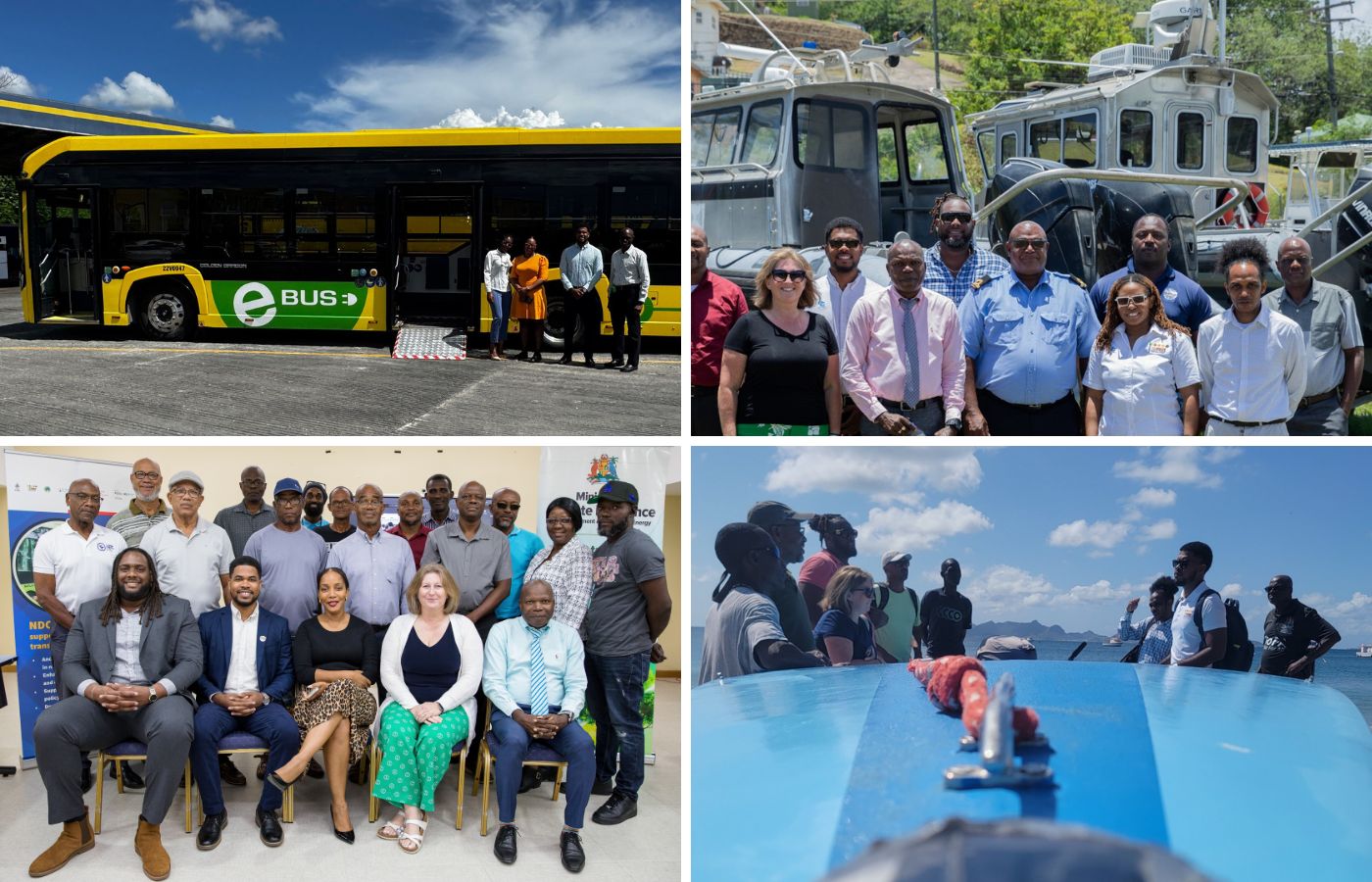
Through the NDC Transport, Energy and Climate (NDC TEC) Project, funded by German Corporation for International Cooperation (GIZ), CCREEE is advancing electric mobility as a cornerstone of the Caribbean’s energy transformation. Now in Phases I and II, the initiative supports Antigua and Barbuda, Belize, Saint Lucia, Jamaica, and Grenada, integrating EV deployment, solar-powered charging, and business-model innovation to accelerate implementation of Nationally Determined Contributions (NDCs).
By 2025, NDC TEC will deliver key milestones, including pilot-project completion, EV procurement, collaboration with utilities on charging infrastructure, and targeted capacity-building programmes to strengthen local institutions. Leveraging the CARICOM Energy Knowledge Hub and the Regional Electric Vehicle Strategy (REVS), CCREEE ensures that lessons learned are scalable, replicable, and investment-ready—positioning the Caribbean as a global leader in sustainable transport among Small Island Developing States (SIDS).
Why Barbados Fits the “Smart Hub” Thesis for FDI
Barbados’ success story is part of a wider Caribbean shift toward resilient, sustainable growth but its distinct combination of policy consistency, infrastructure readiness, and regional connectivity makes it especially attractive for investors.
A Test-and-Scale Market: With a compact geography, reliable grid, and strong institutions, Barbados is the ideal testbed for fleet electrification, depot charging, and smart energy pilots. Transport accounts for about one-third of national energy use, so every investment in e-mobility delivers measurable benefits.
Predictable Policy and Clear Pathways: A 100 percent renewable energy target by 2030, coupled with low grid losses and transparent regulation, provides confidence in long term returns. The ETIP 2025 identifies BBD 19 billion in potential investments through 2040, including major opportunities in transport, charging, and renewable generation.
Regional Reach and Collaboration: As host to CCREEE, Barbados connects investors to a broader Caribbean network of policy frameworks, technical expertise, and data through the CARICOM Energy Knowledge Hub, enabling projects proven on the island to scale region wide.
Human Capital and Skills: Local universities and vocational programmes are producing the next generation of engineers, installers, and energy professionals creating a skilled workforce ready to support both national and regional clean energy expansion.
A Smart Hub Ready for Global Partnerships
Barbados stands at the forefront of the Caribbean’s clean-energy and transport transformation, a place where opportunity meets execution. With nearly 30 percent renewable-energy penetration, grid losses below 7 percent, and multi-billion dollar investment pipelines driving growth in charging, fleet electrification, and renewable integration, the island offers a stable, innovation-ready environment for forward-looking investors.
Opportunities abound across public and commercial charging, fleet-finance models, skills development, and smart-grid services, all underpinned by clear policy direction and regional connectivity. Supported by a capable workforce and anchored in strong institutional frameworks, Barbados has proven that sustainability and profitability can advance together.
For foreign direct investors seeking a trusted base to deploy and scale sustainable technologies across the Caribbean, the message is unmistakable: Barbados is the region’s Smart Hub for electrified mobility and renewable-energy innovation, today and for the decade ahead.
Latest Edition